
In real estate, images are the “weapon” that creates the first impression for customers. Today, many environments and photographers are asking the question: traditional real estate photography and AI – which is more effective? The development of AI technology brings optimal speed and cost, but manual editing (manual photo editing) still brings benefits in sophistication and authenticity. So, AI and manual photo editing, which is the future of real estate marketing?
The reality of the US market for traditional vs AI real estate photos

- In a highly competitive environment, images often determine whether a customer will click on a listing or not.
- According to NAR (National Association of Realtors), 87% of buyers believe that photos are the most important element in a property listing.
- Advertisements with high-quality photos record a click-through rate (CTR) 3 times higher than listings with only text.
- In particular, with MLS (Multiple Listing Service) in the US, images must comply with standards of honesty. Photos that are overly edited may be rejected for posting.
Benefits of AI for photographers

Opportunities:
- Save 30–50% of editing time → take on more projects.
- Increase income by processing large volumes of listings quickly.
- Focus on high-quality photography instead of spending hours on editing.
Risks:
- AI can devalue professional photography services (clients think any photo can be edited).
- If you only use AI, photos may be seen as unnatural → affecting luxury branding.
- Some MLS listings may reject photos that are too “fake”.
Traditional photo editing method
Traditional photo editing is the process where the photographer or post-production specialist uses specialized software (such as Photoshop, Lightroom) to manually process each detail in the photo.
Advantages:
- High precision, can be adjusted according to your wishes and personal style.
- Maintain the natural aesthetics of the image.
- Flexible in handling complex requests such as sky replacement, perspective adjustment, difficult light balance.
Disadvantages:
- Time-consuming and labor-intensive.
- High cost, especially when editing a large number of photos.
- Depends heavily on the skills of the editing specialist.
AI Photo Editing
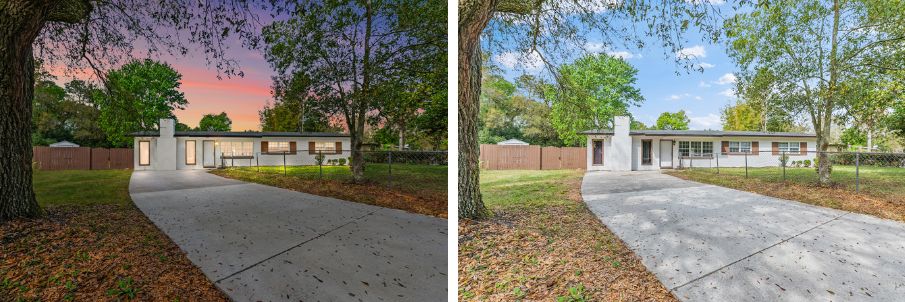
AI in real estate photo editing uses machine learning algorithms to automatically improve lighting, color, remove objects, even replace the sky or add virtual furniture in seconds.
Advantages:
- Extremely fast processing speed, suitable for large volumes of photos.
- Lower cost than hiring manual editing.
- Easy to use, even for non-professionals.
Disadvantages:
- Lack of sophistication in complex details.
- Results sometimes look “fake” or unnatural.
- Difficult to meet creative requirements or unique styles.
Comparing AI and Traditional Editing in Real Estate

| Criteria | Traditional Editing (Manual) | AI Editing |
| Image Quality | High, natural, detailed fine-tuning based on requirements | Stable, fast, but sometimes lacking refinement |
| Processing Speed | Slow, requires significant time for each photo | Fast, capable of bulk processing in just minutes |
| Cost | High, depends on manpower | Low, optimized for marketing budgets |
| Creativity | Flexible, allows personal style and customization | Limited, depends on pre-set algorithms |
| Scalability | Suitable for small projects with detailed requirements | Suitable for large projects with high photo volume |
| Natural Look | Preserves authenticity, ideal for high-end or luxury listings | Risk of looking “artificial,” less natural if overused |
Which method should you choose?
The answer depends on your needs and goals:
- If you are a high-end photographer or agent who wants to differentiate yourself with unique and luxurious images, traditional editing will be suitable.
- If you are a company or brokerage with a large real estate volume, AI will help save costs, time and speed up the marketing process.
In fact, many real estate businesses today are combining both AI and manual editing: AI to quickly process large numbers of photos, then manually refine the most important images.
Conclusion
In the race for customer attention, both AI and traditional photo editing have their place. AI offers speed and cost optimization, while manual editing still holds the advantage of creativity and sophistication. If you are a photographer or real estate team looking to optimize your photo editing workflow, contact Koloheaven for advice on how to integrate AI editing without losing the value of your professional services.